Dhaka ·
  Thimphu ·
  Vancouver · Since 2012
Money is personal, and so is language. For millions of families in Bangladesh and in Bengali-speaking parts of India, the easiest way to talk about rent, school fees, groceries and savings is in Bangla. Yet most finance tools assume everyone is comfortable managing money in English. A personal finance app in Bangla removes that barrier, so everyone in the household can understand the numbers and take part in decisions.
This article looks at why language matters for budgeting, how a bilingual setup helps families work together, and how to get started with FinTrack, the finance tracker from FLEX InfoTech whose web interface is available in both English and Bangla.
The hidden problem with English-only finance apps
Many households have one person who handles the money because they are the one who is comfortable with the app or spreadsheet. Others in the family, perhaps a parent, a spouse or an older relative who manages daily bazaar spending, are left out because the tool feels unfamiliar. When only one person can read the budget, decisions are made in isolation and spending recorded by others goes missing.
Language also affects accuracy. If category names or buttons are confusing, people put expenses in the wrong place or skip recording them altogether. Over a few months, those small errors make reports unreliable, and the family loses trust in the numbers. A tool in a familiar language is not just a convenience; it is what makes shared budgeting work.
What a personal finance app in Bangla should do
Translation alone is not enough. A useful tool should handle the full range of household money movements and make them easy to review together. Look for these capabilities.
- A full Bangla interface option, with the ability to switch to English for family members who prefer it.
- Separate accounts for cash, bank and cards, so each balance is clear.
- Income, expense, transfer, investment and loan records, including money lent to relatives.
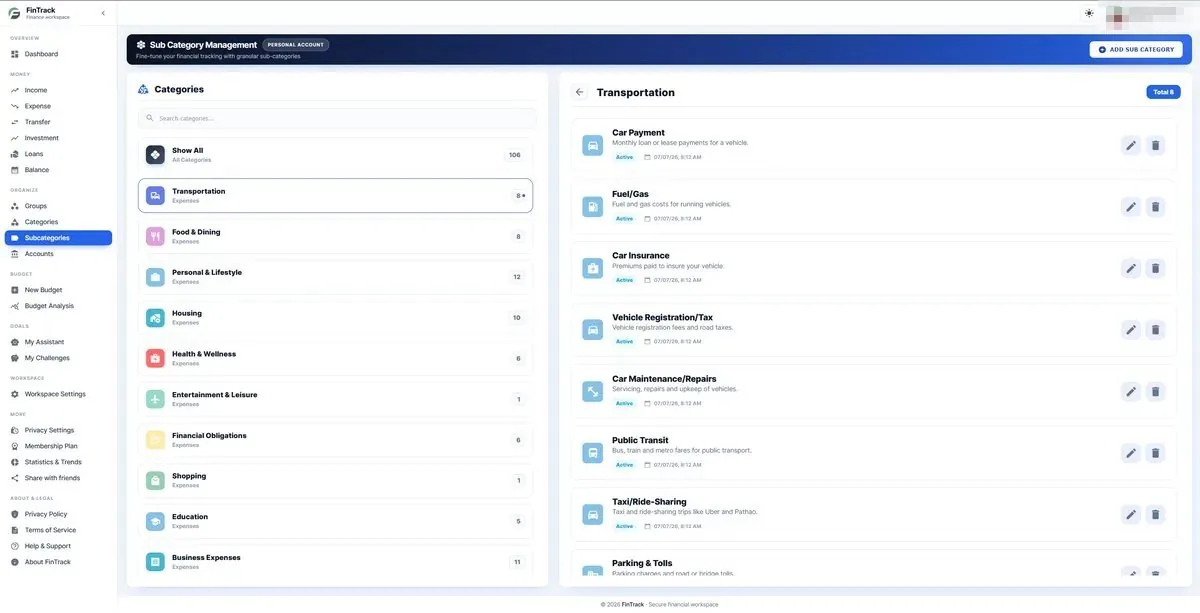
- Flexible categories and subcategories that reflect local life, such as bazaar, school fees, house rent, gas and electricity, and gifts during festivals.
- A budget planner with a clear comparison of planned versus actual spending.
- Savings goals and bill reminders that the whole family can see.
How FinTrack supports Bangla and English
FinTrack's web app at app.fintrackhub.com offers a bilingual interface in English and Bangla, so you can choose the language that suits you. There is also an Android app that works with the same account, which is handy for recording cash spending on the go.
Under the surface, the features are the same whichever language you use. You can record income, expenses, transfers, investments and loans against cash, bank and card accounts; plan budgets by category group; track savings challenges; and set bill and payment reminders through the My Assistant feature. The dashboard shows wallet balances, recent transactions and income-versus-expense charts for today, the last seven days, the month, the year or a custom range.
Family budgeting in Bangla: a step-by-step plan
A family budget works best when everyone agrees the structure first. Sit down together for half an hour and follow these steps.
- List every source of income, including salary, business earnings and money received from relatives abroad.
- Create an account for each place money is kept: the household cash box, each bank account and each card.
- Agree a short list of category groups, such as Home, Food, Education, Health, Transport and Family, and name them in the words your family actually uses.
- Decide who records which spending: for example, one person records bazaar cash and another records bills paid from the bank.
- Set a monthly budget for each group, starting with fixed costs and leaving room for small daily spending.
- Review the dashboard together at the end of each month and adjust the plan.
Saving for the big moments: Eid, Puja, weddings and education
Families in the region often face a handful of large, predictable expenses each year: festival shopping and gifts during Eid or Durga Puja, a relative's wedding, school admission or a child's university costs. These are easier to manage when they are planned months ahead rather than funded at the last minute.
Use a savings challenge for each major goal. Set a target, record each deposit as you make it, and watch the completion percentage grow. Seeing progress in a shared view motivates everyone, including children who are learning how saving works. Combine this with reminders for school fees and utility bills so nothing important is missed during busy months.
Keeping money records simple and private
Good records do not need to be complicated. Per-account statements, which FinTrack can export to PDF or Excel, give you a clean monthly record for your own files, for a landlord or for a family member managing money from abroad. Automatic monthly opening and closing balances mean you do not have to calculate carry-forward amounts by hand.
Treat your finance data with care. Use a strong password, avoid sharing your login on shared devices, and only invite people you trust into a shared space. Small habits like these protect your family's privacy while still letting everyone take part.
Frequently asked questions
Is FinTrack fully available in Bangla?
The FinTrack web app at app.fintrackhub.com has a bilingual interface in English and Bangla, so you can switch to the language you prefer. The Android app works with the same account, which makes it easy to record cash spending away from a computer. Check the web app for the current language options when you sign in.
Can people in West Bengal or other parts of India use a Bangla finance app?
Yes. Any Bengali speaker can benefit from managing money in their own language, whether they live in Bangladesh, West Bengal, Tripura or elsewhere. FinTrack lets you record income and expenses, plan budgets and track savings goals, and its web interface works in Bangla and English for households that mix both languages.
Can I record money lent to relatives?
Yes. Loans are one of the transaction types you can record, alongside income, expenses, transfers and investments. Recording money lent to or borrowed from family helps you remember who owes what without awkward conversations later. You can review these entries any time in your transaction history and account statements.
Does it connect to my bank automatically?
No. You record transactions yourself, which many people find helps them stay aware of each payment. Create an account for each bank, card and cash wallet, enter opening balances, and log transactions regularly. The dashboard, budgets and statements then update from your entries, giving you a clear picture of your household finances.