Dhaka ·
  Thimphu ·
  Vancouver · Since 2012
Choosing garage management software in Bangladesh starts with an honest look at how your workshop runs today. In many garages in Dhaka, Chattogram, Sylhet and other cities, the job card is a paper slip, parts sales are written in a separate khata, stock is counted only when something runs out, and the owner learns the day's takings by asking the cashier at closing time.
This guide is for owners and managers of car, microbus and light vehicle workshops in Bangladesh who want to move to a proper system. It explains the features that matter most for local garages, the questions to ask before choosing, and how GarageDesk, the garage management system built by FLEX InfoTech for Bangladesh and Bhutan, handles each area.
Why Bangladeshi workshops lose money on paper
A busy workshop handles labour, parts, customers and cash at the same time. When the job card, parts register and cash book are separate, they drift apart. A filter is fitted but never billed. A part is sold over the counter but not removed from stock. A customer pays half today and half next week, and the balance is forgotten.
None of these is dramatic on its own, but together they make it hard for the owner to know true profit, which mechanics are most productive or which parts need reordering.
- Parts used on a job that never appear on the bill
- Stock registers that do not match the shelves
- Partial payments and credit customers tracked from memory
- No clear view of which vehicles are waiting, in progress or ready
- Day-end cash totals that are hard to reconcile
Core features of garage management software in Bangladesh
The single most important feature is a job card that carries both labour and parts and becomes the invoice. If the bill is generated from the job card, anything fitted to the vehicle is billed, and anything billed is removed from stock. Everything else builds on that link.
- Job cards with labour and parts that move through clear statuses
- Conversion of the job card into an invoice with PDF output
- Partial payments, money receipts and receivables tracking
- Parts inventory with stock issue, low-stock list and stock takes
- A POS for walk-in parts sales at the counter
- Appointments and bay scheduling for technicians
- Daily, revenue, technician and receivables reports
Local needs: BDT, VAT, Bangla and mobile money
Software made for other markets often fits awkwardly in Bangladesh. GarageDesk lets each garage set its own currency and tax, so a Bangladeshi workshop works in BDT and applies the VAT rate it is required to charge. The full interface is available in Bangla and English, which matters when front-desk staff and technicians are more comfortable in Bangla.
Customers in Bangladesh pay in cash, by card, by bank transfer or through mobile financial services. In GarageDesk, bKash and Nagad can be recorded as payment methods alongside cash, so the day-close summary shows how money came in. The software records these payments; it does not connect to a payment gateway or collect money online.
Parts inventory and the counter POS
Parts are often the largest share of a garage's working capital. GarageDesk issues stock to job cards as part of the transaction, so stock moves when parts are used. The counter POS handles walk-in parts sales, and the low-stock list shows what needs reordering before a job is held up.
On Android, staff can scan barcodes with the phone camera, which speeds up stock takes and issues. Supplier records and purchase orders cover parts procurement, and existing parts lists can be imported from Excel or CSV so you do not have to type everything again.
Keeping the counter and the bays in sync
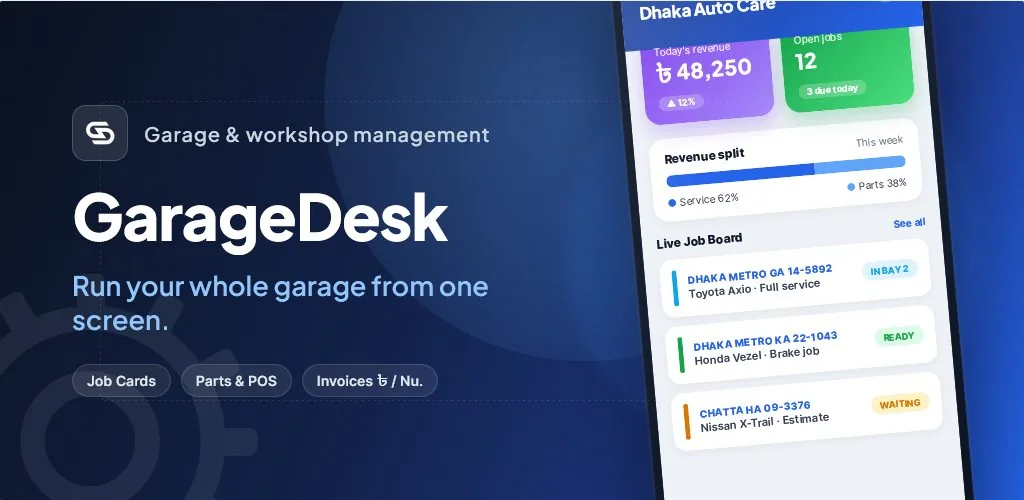
In many workshops, the front desk does not know whether a vehicle is ready until someone walks to the bay. GarageDesk includes a live job board that updates in real time, so the counter and the workshop floor see the same status. Appointments can be assigned to bays and technicians, and the system flags conflicts when two jobs are booked for the same slot.
For larger jobs, you can prepare an estimate or quotation and share an approval link with the customer, who approves it from their phone. Quotes expire automatically, which helps when parts prices change.
Questions to ask before you choose
Whichever product you consider, test it with your own workshop data and include the people who will use it every day: the front-desk officer, a senior technician and the storekeeper.
- Does the job card become the invoice without re-entry?
- Can it handle partial payments and credit customers?
- Does stock move automatically when parts are used or sold?
- Is the interface available in Bangla for front-line staff?
- Can each user have role-based access to only what they need?
- Is there a day-close summary and an audit log of changes?
- Does it work on both a computer and an Android phone?
Frequently asked questions
Can customers pay through bKash or Nagad inside the app?
GarageDesk records bKash and Nagad as payment methods, along with cash and other methods, so your collections and day-close reports show how each payment was received. It does not include a payment gateway, so customers pay in the usual way and the cashier records the payment against the invoice or as a partial payment.
Does the software send SMS to customers?
Not yet. SMS gateway integration for Bangladesh and Bhutan is under development and is not active at present. Invoices and receipts can be produced as PDFs and shared with customers, and quotations can be shared through a secure approval link that the customer opens on their phone.
Can I use it on my phone?
Yes. The system runs as a web app at app.mygaragedesk.com and as an Android app built from the same codebase. Owners can check the dashboard and reports from a phone, while storekeepers can use the phone camera to scan parts barcodes during stock issues and stock takes.
Is it suitable for a small workshop with a few mechanics?
Yes. Each garage is set up as its own account with role-based access, so a small workshop can start with just the owner and a front-desk user and add technicians and a storekeeper later. The job card, invoice, payment and stock flow is the same regardless of size.