Dhaka ·
  Thimphu ·
  Vancouver · Since 2012
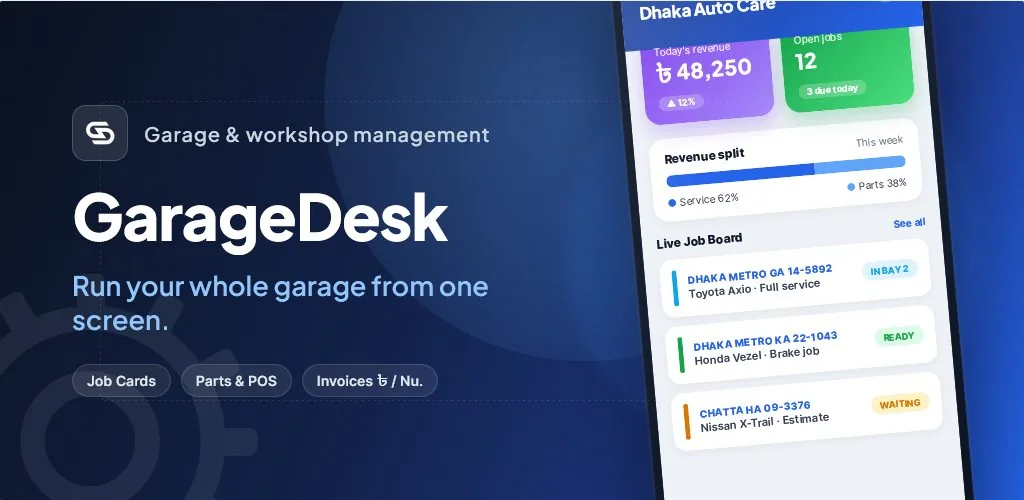
Car workshop software in Bhutan has to suit the way garages actually work here: compact workshops with a handful of experienced mechanics, parts that often have to be ordered and brought in from across the border, customers who know the owner personally, and a busy front desk that handles bookings, billing and collections at the same time. In Thimphu, Paro, Phuentsholing, Gelephu and other towns, many workshops still rely on paper job cards and a ledger book.
This article looks at the problems that approach causes and how GarageDesk, the garage management system developed by FLEX InfoTech for Bhutan and Bangladesh, solves them. FLEX InfoTech has an office in Thimphu, so Bhutanese workshops can get local guidance when setting up.
Problem: job cards that do not match the bill
When the job card is a paper slip and the invoice is written separately, small items slip through. An extra hour of labour, a set of bulbs or a top-up of oil may be done on the vehicle but never make it onto the bill. Over a month, these gaps add up.
The solution is a job card that carries both labour and parts and becomes the invoice. In GarageDesk, the job card moves through statuses from intake to completion and then converts into the invoice, so what was done is what gets billed.
Problem: parts stock that nobody trusts
Because many parts are ordered in and lead times can be long, running out of a common item can keep a vehicle in the bay for days. Yet many workshops only discover a shortage when the mechanic goes to the shelf. Stock registers rarely match reality because issues to jobs and counter sales are not always written down.
Connected stock fixes this. When parts are added to a job card or sold through the counter POS, stock is issued in the same transaction. A low-stock list shows what to reorder in good time, supplier records and purchase orders cover procurement, and periodic stock takes keep the numbers honest. On Android phones, staff can scan part barcodes with the camera to speed up issues and counts.
- Stock moves automatically when parts are used or sold
- Low-stock list for planning orders before items run out
- Supplier records and purchase orders in one place
- Stock takes with barcode scanning on mobile
- Parts lists importable from Excel or CSV
Problem: payments in parts and unclear daily takings
Regular customers and business accounts often pay part of a bill now and the rest later. Without a system, these balances live in the owner's memory or at the back of a notebook. At the end of the day, reconciling cash with the jobs that were completed is slow.
GarageDesk records partial payments, issues money receipts and tracks collections and receivables. The day-close summary gives the owner a clear view of the day's business, and an audit log records changes, which helps when several staff share the front desk. The system records payments; it does not include an online payment gateway.
How car workshop software in Bhutan should handle Ngultrum and tax
Each garage in GarageDesk has its own currency and tax settings, so Bhutanese workshops invoice in Ngultrum (BTN) and apply the tax treatment their business follows, without being forced into a format designed for another country. Invoices and receipts are produced as PDFs that can be printed or shared.
The interface is fully bilingual in English and Bangla. For most Bhutanese teams, English will be the working language, and it covers every screen from job cards to reports.
Problem: the counter does not know what the bays are doing
Customers call to ask whether their vehicle is ready, and the front desk has to walk to the workshop to find out. GarageDesk includes a live job board that updates in real time, so the counter and the bays see the same status at the same moment.
Appointments can be assigned to specific bays and technicians, with automatic conflict detection to prevent double booking. For bigger repairs, the workshop can send the customer a quotation with a secure approval link, so work starts only after the customer has agreed. Quotes expire automatically, which protects the workshop when parts prices change.
Getting started in a Bhutanese workshop
Start with the basics: set up your garage account, currency and tax, add your team with the right roles, and import your parts list. Then run all new jobs through job cards for a few weeks before moving older credit balances into the system. Ask the storekeeper to do a full stock take on day one, so the opening stock is accurate and the low-stock list can be trusted from the start.
GarageDesk works in a web browser at app.mygaragedesk.com and as an Android app, so the owner can check reports from a phone while staff work on a desktop at the counter.
Frequently asked questions
Does the software support Ngultrum?
Yes. Each garage account has its own currency and tax settings, and the system supports both BTN and BDT. A Bhutanese workshop sets Ngultrum as its currency and configures the tax it applies, and invoices, receipts and reports then appear in Ngultrum.
Can customers receive SMS updates about their vehicle?
Not at present. SMS gateway integration for Bhutan and Bangladesh is still under development. Workshops can share invoice and receipt PDFs with customers, and quotations can be sent through a secure approval link that the customer opens and approves on their own phone.
Is local help available in Bhutan?
FLEX InfoTech has an office in Thimphu as well as its head office in Dhaka. Workshops in Bhutan can arrange a free demo and get guidance on setting up their garage account, team roles, parts list and tax settings before they start using the system day to day.
Can several staff use the system at the same time?
Yes. Owners, managers, front-desk staff, technicians and storekeepers can each have their own login with role-based access. Because the job board updates in real time, the counter sees a job move to ready as soon as the technician updates it, and the audit log shows who changed what if questions come up later.