Dhaka ·
  Thimphu ·
  Vancouver · Since 2012
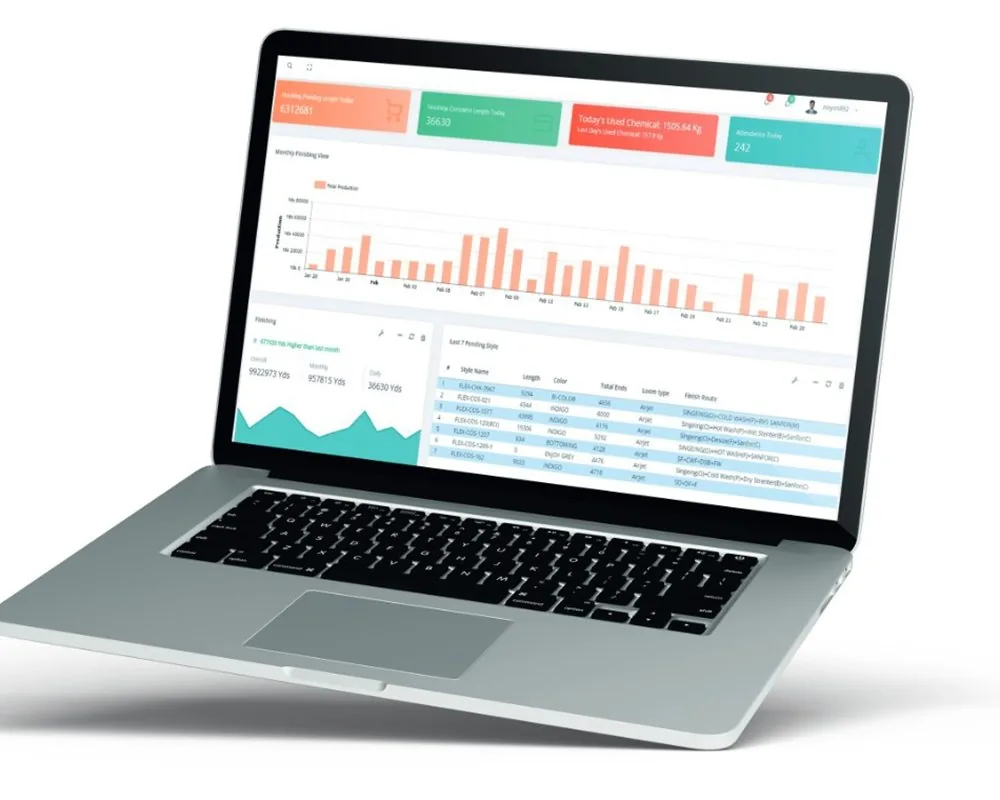
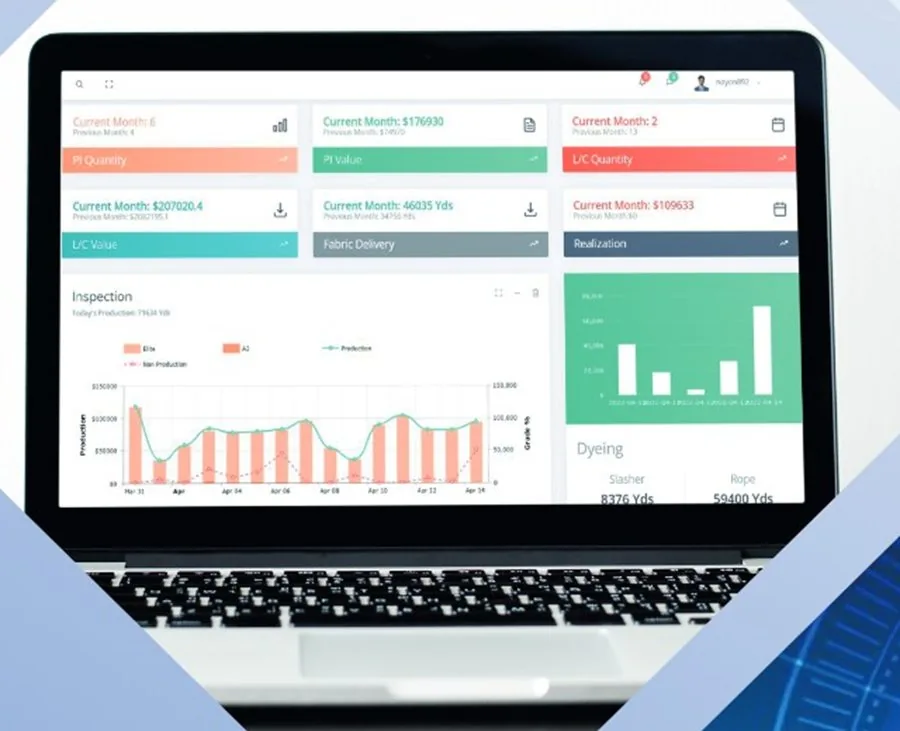
Denim ERP software has to do much more than record purchases and sales. A denim mill runs indigo dyeing, sizing, weaving and finishing in a fixed sequence, and every stage has its own recipes, consumption, wastage and quality checks. A system built for general manufacturing often struggles to represent this, and the mill ends up keeping its real data in spreadsheets beside the ERP.
Whether your mill is in Bangladesh, the checklist below will help you test any vendor with concrete questions rather than brochure claims. For each point we note how FLEX ERP, the denim ERP developed by FLEX InfoTech, approaches it, so you have a reference when comparing options.
Why denim needs a specialised ERP
In denim, a single production order passes through warping, rope or slasher dyeing, long chain beaming, sizing, weaving, finishing, inspection and quality clearance. Yarn counts, beam sets, shade and shrinkage all affect the final fabric. If the system cannot follow the order through these stages set by set, management loses sight of where cost and wastage are building up.
A specialised system also needs to understand the stores a denim mill really runs: yarn, dyes and chemicals, general items and finished fabric, each with its own requisitions and issues.
Finally, denim mills in this region usually sell into export supply chains, so the commercial side carries proforma invoices, export LCs and back-to-back import LCs for yarn and chemicals. An ERP that handles production well but leaves commercial records outside the system only solves half the problem. Use the twelve questions below as a structured script for vendor meetings, and ask for each answer to be shown on screen rather than described.
Questions 1 to 3: sales, sampling and R&D
Fabric development is where most denim orders begin. Your ERP should capture it from the start rather than picking up the order only at production.
- 1. Can it manage swatch cards and sample development requisitions with electronic approval? FLEX ERP includes swatch card information, analysis sheet observations and SDRF with electronic approval.
- 2. Does R&D support fabric analysis, new development, re-engineering and re-make, with a bill of materials and yarn count management?
- 3. Can the system turn a received order into a PO sheet with approval, and raise yarn requisitions order-wise or for samples?
Questions 4 to 6: costing and planning
Margins in denim are sensitive to yarn price, dye and chemical consumption and wastage at each stage. Costing must be tied to real production data.
- 4. Is there a pre-cost before the order with automatic overhead calculation and budget analysis?
- 5. Is post-costing done after each production segment, set by set, with BOM versus post-cost and pre-cost versus post-cost reports?
- 6. Can planners manage production orders, plan sheets, order-wise or bulk yarn requisitions, chemical requisitions, set planning and order settlement?
Questions 7 to 9: what denim ERP software must track on the floor
This is where generic systems usually fall short. Ask the vendor to show each stage on screen with realistic data.
- 7. Does warping cover rope, direct, ecru, sectional and re-cone work, with daily production, yarn reconciliation and wastage analysis?
- 8. Does dyeing support rope and slasher recipes, a chemical sub-store and chemical consumption analysis, and does sizing generate beam cards automatically?
- 9. Does weaving support air-jet and rapier looms with automatic mount and doff cards and crimp percentage analysis, and does finishing record recipes and shrinkage analysis?
Questions 10 to 12: inspection, stores, delivery and finance
Once fabric is inspected, it becomes stock with commercial value. Tracking each roll accurately protects both quality and revenue.
- 10. Are inspected rolls labelled with QR-coded stickers, with roll cutting, repacking and section-wise wastage reports, and QA steps such as beam clearance, shade declaration and fabric roll clearance?
- 11. Can the fabric store receive by scan, record roll locations, and deliver against delivery orders with automatic challan and gate pass?
- 12. Does the commercial and finance side cover export and import LCs, PI-wise and DO-wise party balances, payment realisation and full accounts?
Infrastructure and rollout questions
Beyond features, ask how the system runs day to day. Mills in South Asia often face power interruptions and unstable internet in industrial zones. FLEX ERP works on the mill's local network without depending on the internet, with remote access through a global IP for management.
Ask how modules can be phased in, how many users can be added later, how upgrades are handled and what support looks like after go-live. A modular, scalable system lets you start with the departments that need it most and extend as the team gains confidence.
- Ask for a demo using one of your own recent orders
- Include store, floor and QA supervisors in the evaluation
- Check that reports match the format your management already reads
- Agree on a go-live sequence and training plan in writing
Frequently asked questions
What makes denim ERP software different from a general manufacturing ERP?
Denim ERP software models the specific stages of denim production, including warping, rope or slasher dyeing, long chain beaming, sizing, weaving, finishing, inspection and QA clearance. It also handles yarn and chemical sub-stores, beam and roll tracking, shade and shrinkage checks, and set-wise costing, which general systems usually leave to spreadsheets.
Can a mill in India, Pakistan or Sri Lanka use FLEX ERP?
FLEX ERP was developed in Bangladesh for the denim industry, and the production stages it covers are common to denim mills across the region. Mills outside Bangladesh should review their commercial documents, tax handling and reporting needs with the FLEX team during a demo to confirm what fits and what may need configuration.
How long should an evaluation take?
There is no fixed timeline, but a careful evaluation usually includes a first demo, a review of your own order and production flow, and a session with supervisors from stores, production and QA. FLEX InfoTech offers a free demo and a free prototype for new clients, which helps you test the fit before committing.
Do we need to replace our accounting system at the same time?
Not necessarily. Many mills start with production, inventory and commercial modules and bring accounts and finance into the ERP later. Doing it in phases reduces risk, although having accounts in the same system eventually gives the clearest view of costing, receivables and realisation.